VaudTax · Chapter 4/11
Work expenses in VaudTax: commuting, meals, home office and 2026 flat rates
Key points
- Commuting (code 140): flat amount based on the public transport distance (capped at the cost of a GA travelcard, CHF 4,080 in 2025). A car is only accepted if public transport is not usable: CHF 0.75/km up to 15,000 km in 2026.
- Meals (code 150): CHF 3,200 a year if you eat lunch away from home, CHF 1,600 with a staff canteen or employer subsidy.
- Other expenses (code 160): flat 3% of net salary, minimum CHF 2,000, maximum CHF 4,000.
- Home office, short-time work or sick leave: commuting and meal deductions are reduced pro rata to the days actually worked on site.
The principle: flat rate or actual costs
You can deduct the costs needed to earn your salary, provided your employer does not reimburse them. For each category you choose between the flat rate (simple, no receipts) and actual costs (to be proven on request). You cannot combine both for the same category.
Flat rates are based on 240 working days a year. If you worked only part of the year, VaudTax reduces them proportionally. Enter your work interruption periods first (« Périodes d'interruption de travail », same section).
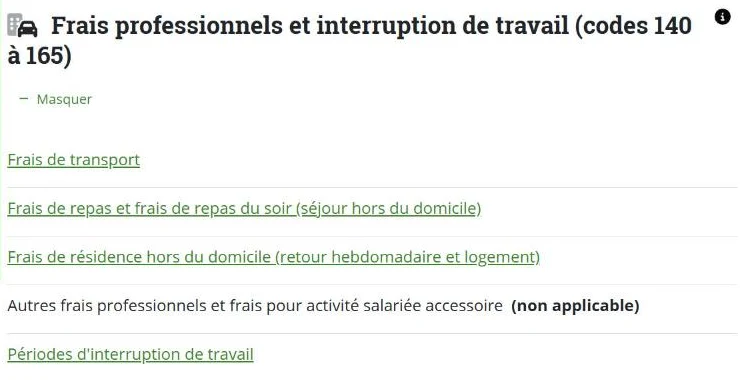
Commuting costs (code 140)
Public transport: the default rule
Vaud grants a flat amount based on the shortest one-way distance between home and work. You enter the kilometres and VaudTax applies the official scale.
| One-way distance | Annual deduction (2025 scale) |
|---|---|
| up to 2 km | CHF 1,176 |
| 5 km | CHF 1,669 |
| 10 km | CHF 2,372 |
| 19 km | CHF 2,976 |
| 30 km | CHF 3,288 |
| 40 km | CHF 3,608 |
| 51 km and more (cap) | CHF 4,080 |
Car, motorbike, bicycle: only if justified
A private vehicle is only accepted if no public transport is reasonably usable (timetables, distance to the stop, many changes, disability) or if you need it for your job. Saving time is not enough. If justified:
| Means of transport | 2026 deduction |
|---|---|
| Car, up to 15,000 km | CHF 0.75 per km |
| Car, beyond 15,000 km | CHF 0.35 per km |
| Motorbike (over 50 cc) | up to CHF 0.40 per km (2025 amount) |
| Bicycle, slow e-bike, moped | up to CHF 700 a year |
Example: 19 km one way × 2 × 240 days = 9,120 km × CHF 0.75 = CHF 6,840. Parking is not deductible on top, and a company car rules out any commuting deduction.
Meal costs (code 150)
| Situation | Annual deduction 2026 |
|---|---|
| Lunch regularly eaten away from home | CHF 3,200 |
| With staff canteen or employer subsidy (box G ticked) | CHF 1,600 |
| Shift or night work all year | CHF 3,200 (not combined with the lunch deduction) |
| Staying near work during the week (lunch and dinner) | CHF 6,400 (CHF 4,800 with a canteen at lunch) |
Other work expenses (code 160)
A flat rate covers tools, special work clothing, professional books, IT equipment and a home study: 3% of net salary, minimum CHF 2,000, maximum CHF 4,000. It is not reduced for home office or interruptions. VaudTax calculates it automatically.
Actual costs only make sense if they clearly exceed the flat rate. Be careful with a home office: it is only accepted if working from home is an obligation (no suitable workplace at your employer) and only for the share of rent for that room.
Side activity expenses (code 165)
For income declared under code 105, the flat rate is 20% of the income, minimum CHF 800, maximum CHF 2,400 (limited to the income if below CHF 800). Example: CHF 6,000 of side income gives a CHF 1,200 deduction.
Home office and interruptions: pro rata reduction
This is the most common mistake. If you work from home two days a week, your commuting and meal deductions drop by about 40%. The 3% flat rate (code 160) does not change.
What about further training?
It does not go into work expenses but into special deductions (code 618), up to CHF 12,000 per person. See Other deductions.
Frequently asked questions
Can I deduct my car if the train takes longer?
No, saving time alone is not enough. A private vehicle is accepted if no public transport is reasonably usable (timetables, long distance to the stop, many changes, disability) or if you need it for your work.
What is the per-km car rate in Vaud for 2026?
CHF 0.75 per km up to 15,000 km a year, then CHF 0.35 per km beyond, according to the ACI table of Vaud deductions for 2026.
I work from home two days a week. What changes?
Your commuting and meal deductions must be reduced in proportion to the days spent at the office (about 3/5 here). The 3% flat rate for other work expenses is not reduced.
Rather hand it over?
NeoFidu prepares and files your Vaud tax return for you, including a check for missed deductions. Service in English available.
This guide is for information only and is not personalised advice. Amounts come from official publications of the Vaud cantonal tax administration (ACI). VaudTax itself is in French: we quote the French labels so you can find them on screen. If in doubt, the official ACI instructions prevail.