VSTax · Chapter 9/11
Deductions in VSTax: insurance premiums, medical costs, donations, training and two-income couples
Key points
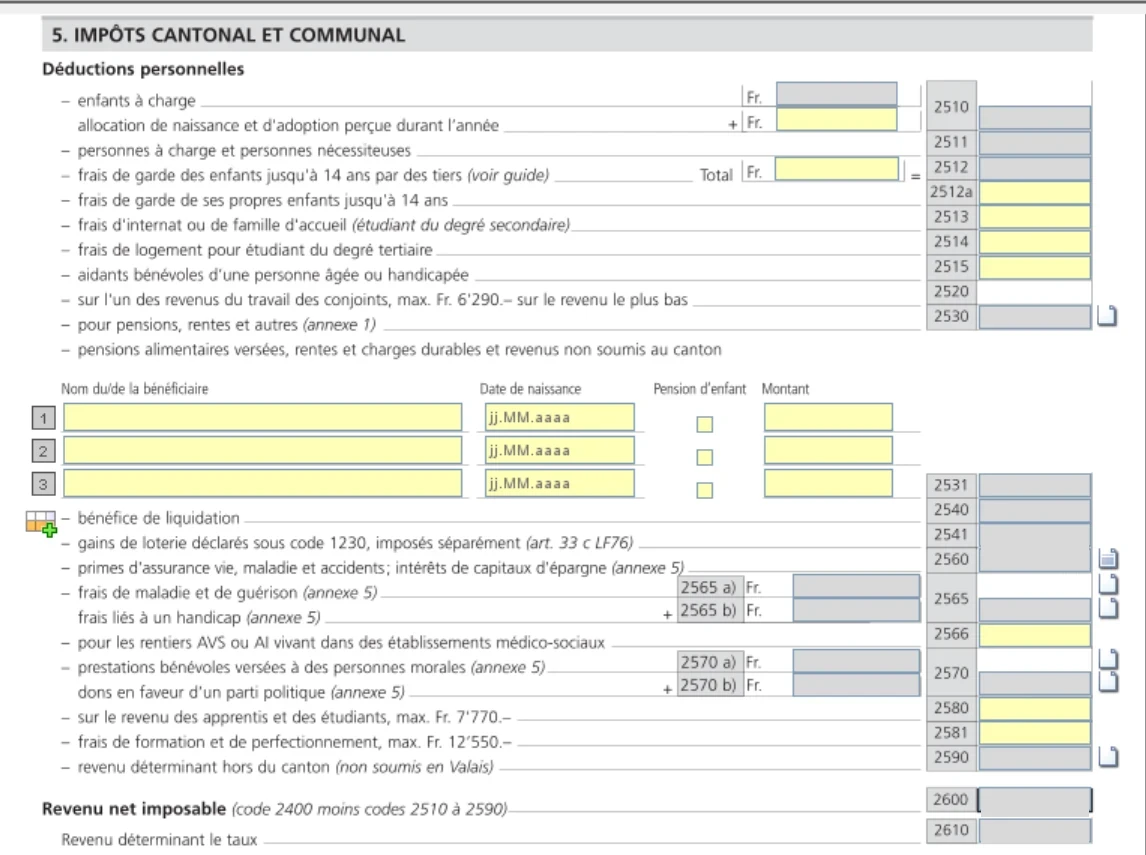
- Health, accident and life insurance premiums, plus savings interest: code 2560, 2026 cap of CHF 7,600 for a couple and CHF 3,800 for a single person, plus CHF 1,130 per child.
- Medical costs: the part above 2% of net income (code 2565, 5% for federal tax). Donations: up to 20% of net income (code 2570).
- Professional training: up to CHF 12,550 per taxpayer (code 2581). Two-income couple: up to CHF 7,000 off the lower income (code 2520).
- These deductions go in the « Autres déductions » (other deductions) form; VSTax carries the totals to page 3 and works out federal tax separately.
Overview of 2026 deductions
| Deduction | Code | Cantonal tax 2026 | Direct federal tax 2026 |
|---|---|---|---|
| Insurance premiums and savings interest, couple | 2560 | CHF 7,600 | CHF 3,700 (CHF 5,550 without 2nd or 3rd pillar) |
| Insurance premiums and savings interest, single | 2560 | CHF 3,800 | CHF 1,800 (CHF 2,700 without 2nd or 3rd pillar) |
| Extra per child or dependent person | 2560 | CHF 1,130 | CHF 700 |
| Illness and accident costs | 2565 a | part above 2% of net income | part above 5% of net income |
| Disability-related costs | 2565 b | actual costs or flat rate | actual costs or flat rate |
| Donations to public-benefit organisations | 2570 a | max. 20% of net income | max. 20%, from CHF 100 |
| Political party contributions | 2570 b | max. CHF 20,930 | separate federal cap |
| Professional training | 2581 | max. CHF 12,550 per taxpayer | separate federal cap |
| Two-income couple | 2520 | max. CHF 7,000 off the lower income | 50% of the lower income, min. CHF 8,600, max. CHF 14,100 |
| Volunteer carer of an elderly or disabled person | 2515 | CHF 6,030 | no deduction |
Insurance premiums and savings interest (code 2560)
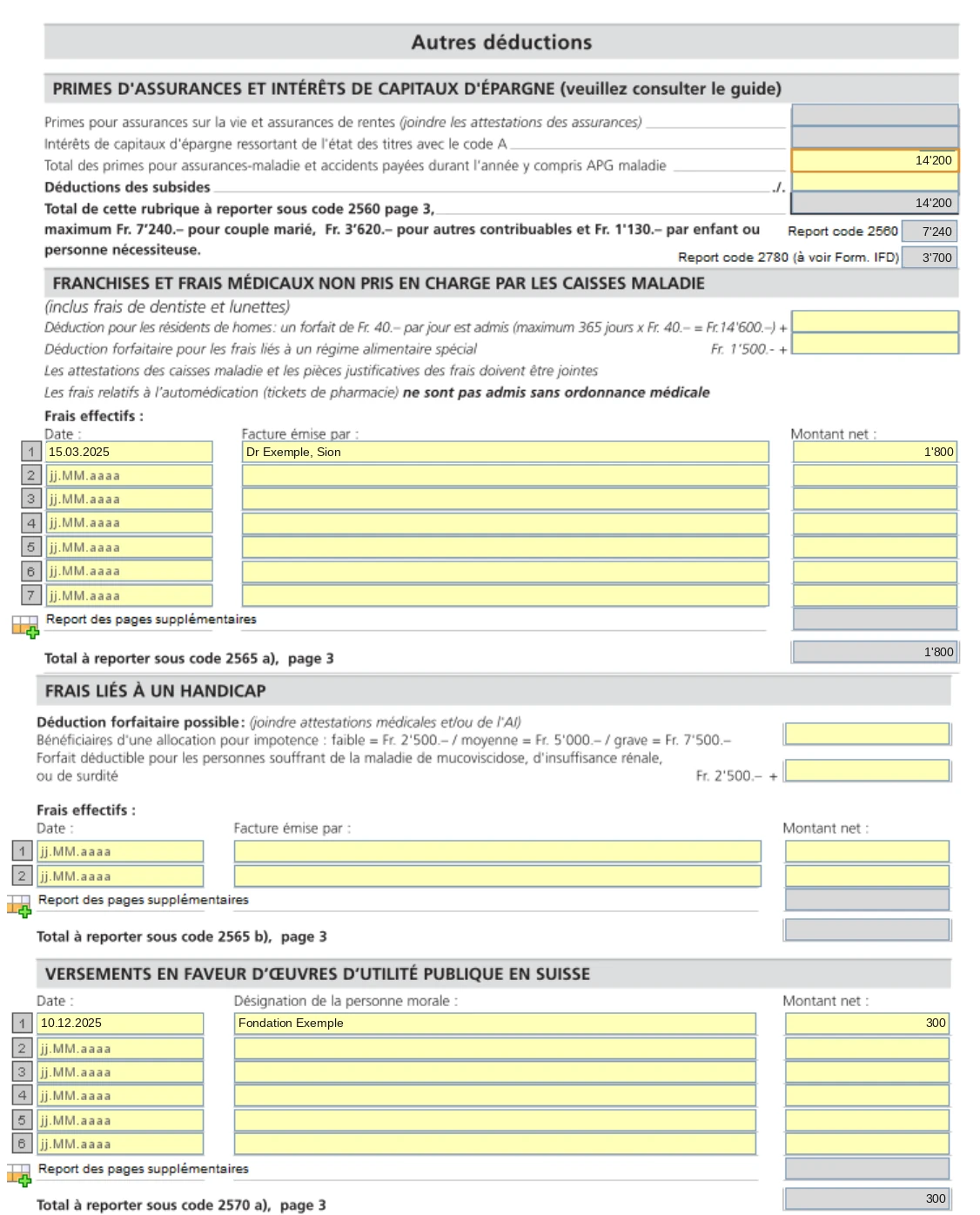
The form adds up life and annuity insurance premiums, interest on savings accounts (taken from the securities list, code A) and health and accident insurance premiums paid in 2026, including sickness daily-allowance insurance. It subtracts any premium subsidies received, then applies the cap. With basic health premiums for a family, the cap is almost always reached: just enter the amounts and attach the insurer's annual statements.
Medical and disability costs (code 2565)
Enter the deductibles, co-payments and unreimbursed bills for 2026 (doctor, dentist, glasses, hospital), with the date, issuer and net amount, and attach the health insurer's annual statement. Only the part above 2% of net income (before personal allowances) is deductible for cantonal tax; VSTax does the maths. Medicines are only accepted with a prescription from a doctor or an approved naturopath: pharmacy receipts without a prescription are refused.
- Care home resident: flat CHF 40 a day without receipts, up to CHF 14,600 a year.
- Special diet prescribed by a doctor (diabetes, coeliac disease, for example): flat CHF 1,500 per person, reintroduced in 2025.
- Disability (code 2565 b): actual costs fully deductible, or a flat CHF 2,500, 5,000 or 7,500 depending on the helplessness allowance level, and CHF 2,500 for cystic fibrosis, kidney failure or deafness.
Donations and political parties (code 2570)
Cash or asset donations to Swiss tax-exempt public-benefit organisations (and to the Confederation, cantons and municipalities) are deductible up to 20% of net income. Give the date, recipient and amount, and attach receipts or a signed list. Contributions and donations to a political party that is registered, represented in a cantonal parliament or won at least 3% of the vote are deducted separately, up to CHF 20,930 in 2026.
Training and further education (code 2581)
Training and further education costs for professional purposes, including retraining, are deductible up to CHF 12,550 per taxpayer: fees, books, IT equipment, travel, meals and accommodation linked to the course. You must hold an upper-secondary qualification (apprenticeship certificate, baccalaureate) or be over 20 and not studying for a first qualification at that level. In a couple, each spouse has their own cap.
Two-income couples and maintenance payments
When both spouses work, VSTax deducts up to CHF 7,000 (CHF 6,290 in 2025) from the lower earned income (code 2520). The same applies to a spouse who substantially helps in the other's business. For direct federal tax, the deduction is 50% of the lower income, at least CHF 8,600 and at most CHF 14,100.
Maintenance paid as regular payments to a former spouse and for minor children is deducted under code 2531, with the recipient's name and date of birth. Maintenance for an adult child is not deductible.
New 2026 deductions and special cases
- Retirees who keep working: CHF 7,000 off net income for people past the AHV reference age who still have earned income, capped at the net income from that work. For a couple or partners who both work, CHF 7,000 in total.
- AHV pensioners living alone with taxable wealth under CHF 100,000: deduction of CHF 3,000 (taxable income up to CHF 30,000), CHF 2,000 (up to CHF 40,000) or CHF 1,000 (up to CHF 50,000).
- Care home residents: cantonal taxable income is set to zero when income left after care home costs does not exceed CHF 5,490 and there is no taxable wealth.
- AHV contributions not deducted elsewhere (people without earned income, for example): code 2000, « Autres déductions ».
The « Impôt fédéral direct » form
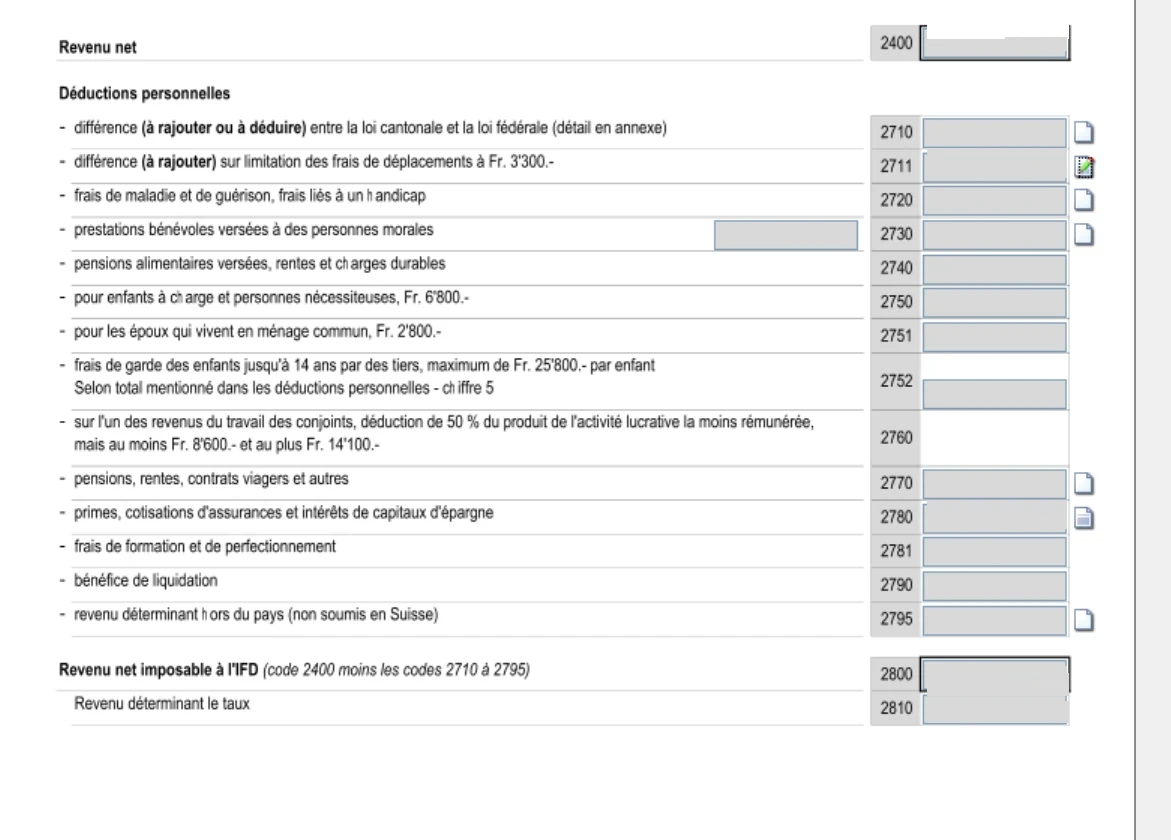
Page 3 of the return calculates cantonal tax. For direct federal tax, VSTax takes net income (code 2400) into the « Impôt fédéral direct » form and applies federal rules: commuting cap difference (code 2711), medical costs above 5% (2720), CHF 6,800 child deduction (2750), CHF 2,800 married couple deduction (2751), childcare up to CHF 25,800 (2752), insurance premiums (2780). You normally have nothing to enter there; the SCC sends the details with your assessment.
Frequently asked questions
How much health insurance can I deduct in Valais in 2026?
Health, accident and life insurance premiums and savings interest are deductible together up to CHF 7,600 for a married couple and CHF 3,800 for a single person, plus CHF 1,130 per child, after subtracting subsidies.
From what amount are medical costs deductible in Valais?
For cantonal tax, the part of unreimbursed costs above 2% of net income. For direct federal tax, the part above 5%. Medicines must be prescribed by a doctor.
What is the two-income couple deduction in Valais?
Up to CHF 7,000 in 2026 (CHF 6,290 in 2025) off the lower earned income. For federal tax, 50% of the lower income, between CHF 8,600 and CHF 14,100.
Are trade union fees deductible in Valais?
No. The SCC guide states that union and professional association fees are not costs of earning income and are not deductible.
Rather hand it over?
NeoFidu prepares and files your Valais tax return for you, including holiday homes and source tax cases, with a check for missed deductions. Service in English available.
This guide is for information only and is not personalised advice. Amounts come from official publications of the Valais cantonal tax service (SCC) and the Swiss Federal Tax Administration. VSTax is only available in French and German: we quote the French labels, followed by a translation, so you can find them on screen. Screenshots show VSTax 2025 with fictitious data. If in doubt, the official SCC guide prevails.