VSTax · Chapter 2/11
Personal situation in VSTax: marital status, children, childcare and the family rebate
Key points
- The personal data window (« Données personnelles ») opens at the start of every new return and is always available from the « Modifier » menu (Ctrl + L). Your situation on 31 December 2026 is what counts.
- Child deduction: CHF 7,860 up to age 6, CHF 8,940 from 6 to 16, CHF 11,930 from 16, plus CHF 1,240 from the third child (code 2510).
- Childcare by third parties: up to CHF 10,000 per child under 14 (code 2512). Looking after your own children: CHF 3,130 (code 2512a), subject to work-rate conditions.
- Married couples and single parents get a 35% rebate on cantonal tax, then CHF 300 per child. Unmarried couples do not.
The personal data window
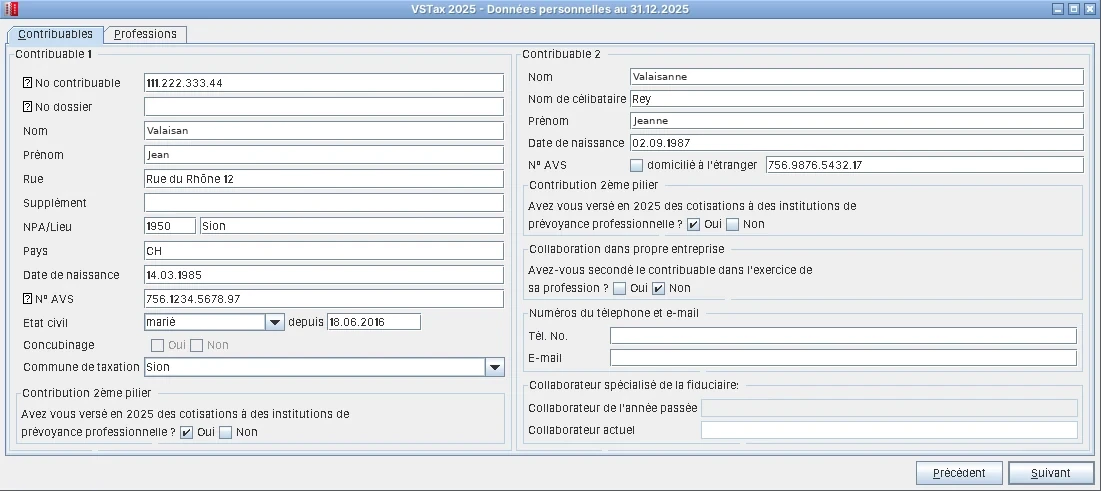
To close this window, VSTax requires: surname, first name, postcode and town, date of birth, AHV number (« N° AVS »), taxpayer number, file number, marital status (« Etat civil »), cohabitation (« Concubinage », except for married couples), municipality of assessment (« Commune de taxation ») and the answer to « Avez-vous versé en 2026 des cotisations à des institutions de prévoyance professionnelle ? » (did you pay pension fund contributions in 2026?). For a married couple, it also needs taxpayer 2's surname, maiden name, first name, date of birth and AHV number, and whether they help in the other's business.
The Professions tab lets you pick your main and secondary occupation from two lists, « Classe » (field) then « Profession ». If yours is missing, you can type free text.
Marital status, marriage, separation and moving in 2026
| Situation in 2026 | Effect on the 2026 return |
|---|---|
| Marriage | One joint return for the whole year |
| Divorce or separation | Separate returns for the whole year |
| Death of a spouse | Joint taxation until the death, then the survivor is taxed alone |
| Child turned 18 | Taxed separately from the start of the year |
| Moved from another canton | Taxed in Valais for all of 2026, all income included |
| Moved from abroad | Taxed from the arrival date; income from that date to 31 December |
| Moved to another canton | No Valais return for 2026: the new canton taxes the whole year |
| Moved abroad | Return up to the departure date |
Tick Concubinage if you live as a couple without being married. Unmarried partners each file their own return, do not get the 35% rebate or the low-income deduction, and split the CHF 90,000 wealth allowance in half when they have children.
Declaring children (page 1, dependants)
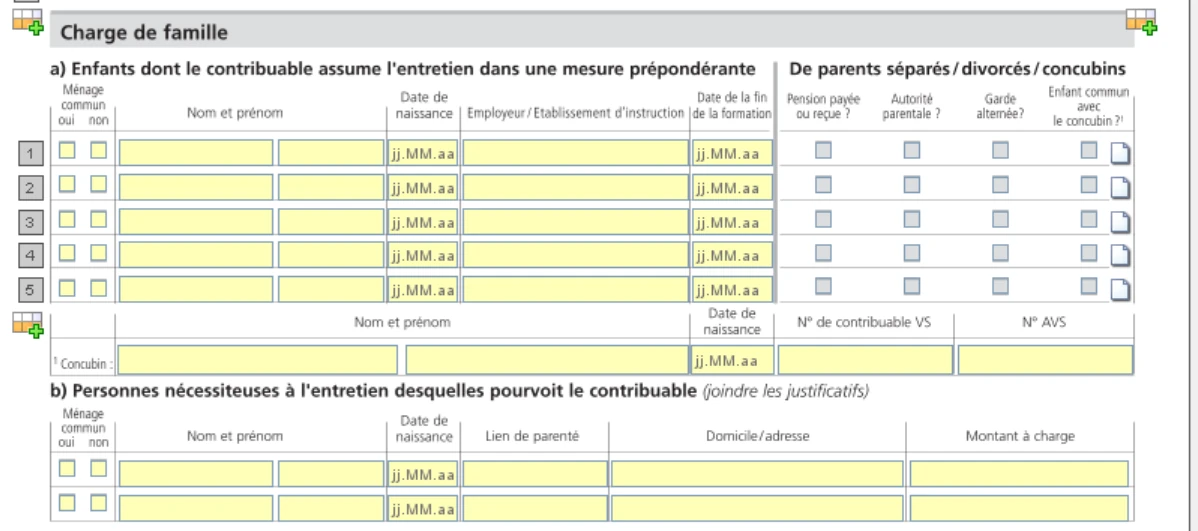
Children are entered under « Charge de famille » (dependants) on page 1 of the return: name, date of birth, same household, employer or school and end date of training. For separated, divorced or unmarried parents, VSTax also asks whether maintenance is paid or received, who has parental authority, whether custody is shared and whether the child is shared with the partner. These answers decide who gets the deduction.
| Dependent child (situation on 31 December 2026) | Cantonal tax (code 2510) |
|---|---|
| Up to age 6 | CHF 7,860 |
| Age 6 to 16 | CHF 8,940 |
| 16 and over, in education | CHF 11,930 |
| Extra from the third child | CHF 1,240 per child |
| Birth or adoption allowance received in 2026 | Added to the deduction |
| Direct federal tax | CHF 6,800 per child |
- You must bear at least 50% of the child's living and education costs.
- Parents taxed separately with joint parental authority and no child maintenance: each gets half of the deduction.
- A minor child's salary (including apprentice pay) does not go in your return: the child files their own return. Their wealth and other income (interest, orphan's pension) do go in yours.
Childcare: by third parties (2512) or by the parents (2512a)
| Deduction | Cantonal tax | Direct federal tax |
|---|---|---|
| Third-party care (nursery, after-school care, childminder), child under 14 | Actual costs, max. CHF 10,000 per child | Actual costs, max. CHF 25,800 per child |
| Looking after your own children under 14 | Flat CHF 3,130 per child | No deduction |
| Both combined | Allowed, max. CHF 10,000 per child | Not applicable |
Third-party care is deductible if the child lives with you and the costs are documented and directly linked to your work, training or inability to work. The flat rate for looking after your own children is for a single parent working no more than 80% and a couple working no more than 160% combined. You have to claim it in the return.
Other dependants, students and apprentices
| Deduction | Code | 2026 amount |
|---|---|---|
| Dependent person unable to earn a living whom you support | 2511 | CHF 2,510 (federal: CHF 6,800) |
| Boarding school or host family, secondary-level student | 2513 | actual costs, max. CHF 5,710 |
| Housing for a tertiary-level student living away from home | 2514 | max. CHF 10,000 (CHF 5,220 in 2025) |
| Apprentice's or student's own income (in their return) | 2580 | max. CHF 7,770 |
The 35% rebate and the low-income deduction
Valais does not use income splitting. For married couples and single parents living with their children, cantonal income tax is reduced by 35%, at least CHF 680 and at most CHF 4,900, then by CHF 300 per child. Single people without children on low incomes get instead a deduction of CHF 21,250 from taxable income, which falls in steps and disappears above CHF 35,470. VSTax works these out: there is nothing to enter, but your marital status, cohabitation and children must be correct.
Frequently asked questions
How much is the child deduction in Valais in 2026?
CHF 7,860 up to age 6, CHF 8,940 from 6 to 16 and CHF 11,930 from 16 for a child in education, plus CHF 1,240 per child from the third. For direct federal tax, it is CHF 6,800 per child.
How much can I deduct for nursery costs in Valais?
Up to CHF 10,000 per child under 14 for cantonal tax and CHF 25,800 for direct federal tax, with receipts, if the care is linked to your work, training or inability to work.
What is the deduction for looking after your own children?
A flat CHF 3,130 per child under 14 for cantonal tax, for families who look after their children themselves: a single parent must not work more than 80%, a couple not more than 160% combined. It does not exist for federal tax.
Do unmarried couples get the 35% rebate?
No. Valais tax law excludes people living together without being married from the 35% rebate and from the low-income deduction. Each partner files their own return.
Rather hand it over?
NeoFidu prepares and files your Valais tax return for you, including holiday homes and source tax cases, with a check for missed deductions. Service in English available.
This guide is for information only and is not personalised advice. Amounts come from official publications of the Valais cantonal tax service (SCC) and the Swiss Federal Tax Administration. VSTax is only available in French and German: we quote the French labels, followed by a translation, so you can find them on screen. Screenshots show VSTax 2025 with fictitious data. If in doubt, the official SCC guide prevails.