FriTax · Chapter 4/11
Work expenses in FriTax: commuting, meals, the 3% flat rate and home office (schedule 03)
Key points
- Expenses are entered in schedule 03 « Revenu d'activité-Frais d'acquisition », the « Revenus d'activité » form in the « Formulaires » list, or the blue « ... » button next to codes 2.110 to 2.140.
- Commuting (2.110): public transport at actual cost; car at CHF 0.70 per km only if public transport cannot be used; cap of CHF 12,000 for cantonal tax and CHF 3,300 for federal tax.
- Meals (2.120): CHF 15 per day, up to CHF 3,200; half that if your employer subsidises the meal.
- Other expenses (2.130): flat rate of 3% of net salary, at least CHF 2,000 and at most CHF 4,000. Home office days give no commuting or meal deduction.
Schedule 03 « Revenu d'activité-Frais d'acquisition »
The deductions in this chapter apply to your main employment. For each person, schedule 03 asks for the place of work, means of transport, distance, number of working or meal days. FriTax 2025 has no separate home office box: only count the days actually spent at the workplace. FriTax carries the totals over to codes 2.110 to 2.140 of the return. No deduction is allowed for costs your employer paid.
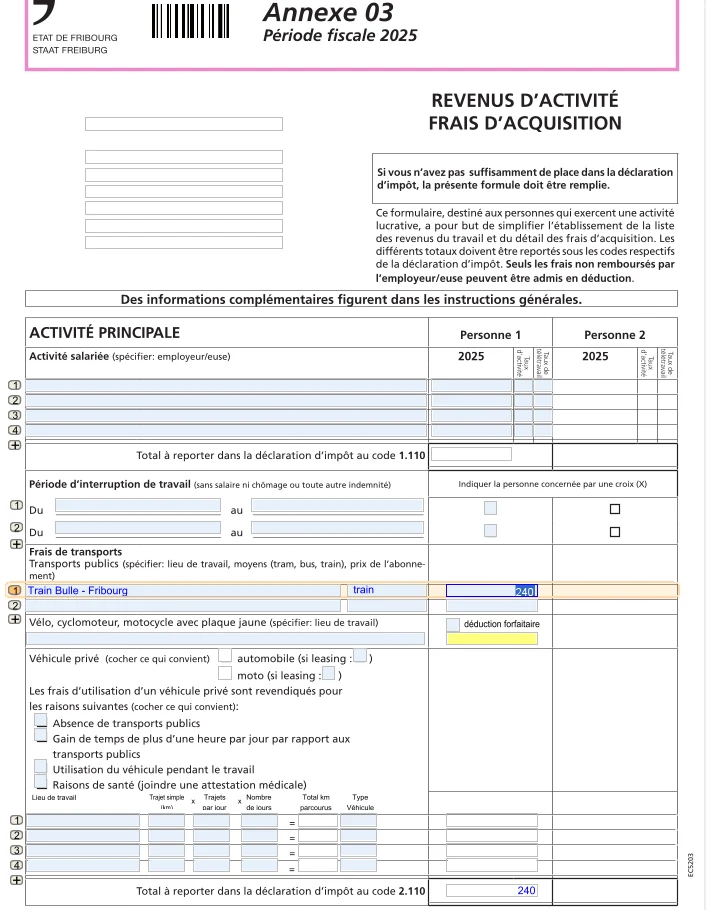
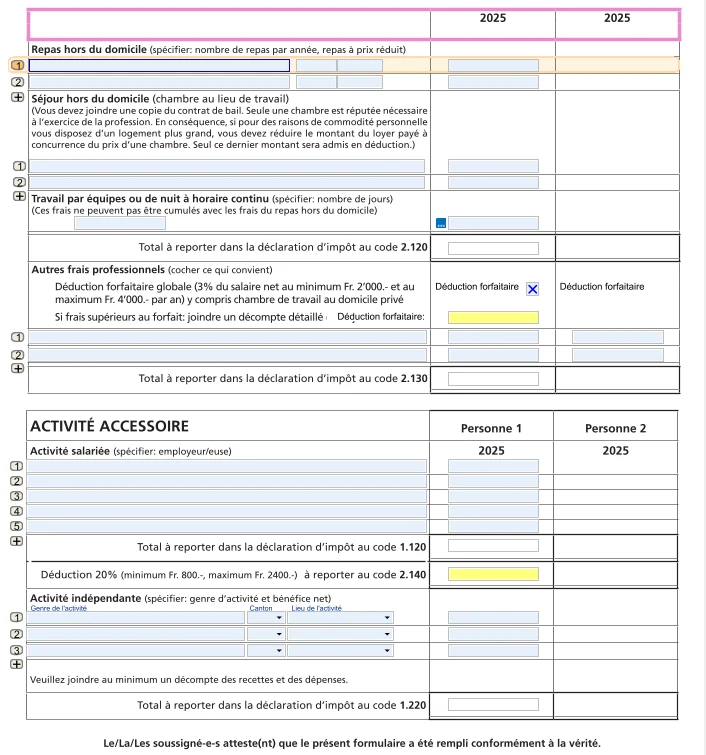
Commuting costs (code 2.110)
| Means of transport | Deduction |
|---|---|
| Public transport | Actual 2nd-class cost (1st class if proven) |
| Bicycle, moped, yellow-plate motorbike | CHF 700 a year |
| White-plate motorbike or private car | The cost of public transport, unless you prove it cannot be used |
| Car, no usable public transport | CHF 0.70 per km up to 10,000 km, CHF 0.60 from 10,001 to 20,000 km, CHF 0.50 beyond |
| Motorbike, no usable public transport | CHF 0.40 per km |
| Going home at lunchtime | Up to CHF 15 a day and CHF 3,200 a year |
| Annual cap | CHF 12,000 (cantonal and municipal tax); CHF 3,300 (direct federal tax) |
Your workplace must be more than 1.5 km from home. The SCC counts 220 working days a year, reduced pro rata for interruptions (unemployment, illness, maternity). A car is only deductible per kilometre if you prove that public transport is unavailable or unusable (disability, distance, unsuitable timetables). When several people travel together, the full deduction is only allowed once; person 2 cannot deduct anything extra if they use the same vehicle as person 1.
For apprentices, travel to vocational school counts as non-deductible training costs. Travel costs of children in education are not deductible either.
Meals, weekly stays away and shift work (code 2.120)
| Situation | Deduction |
|---|---|
| Lunch away from home | CHF 15 per meal, max. CHF 3,200 a year |
| Meal discounted by the employer (canteen, vouchers) | CHF 7.50 a day, max. CHF 1,600 a year |
| Staying near work during the week | CHF 30 a day, max. CHF 6,400 (CHF 22.50 and CHF 4,800 if lunch is subsidised), plus room rent and the weekly trip home |
| Shift or continuous night work | CHF 15 a day, max. CHF 3,200, normally not on top of the meal deduction |
The meal deduction requires that going home for lunch is impossible: distance, irregular hours, a short break or poor connections. No deduction is allowed if a main meal costs you less than CHF 9. For weekly stays near work, attach a copy of the room's lease.
Other work expenses: the 3% flat rate (code 2.130)
The flat rate is 3% of net salary, at least CHF 2,000 and at most CHF 4,000 a year, reduced if you only worked part of the year. A pension fund buy-in deducted from your pay (box 10.2 of the certificate) is included in the base. It covers tools, IT equipment and software, professional books, work clothing, exceptional wear on clothes and the use of a private study. You can instead deduct actual costs, but you must then document all expenses and show they were needed for work.
Training, further education and retraining costs do not go here but under code 4.420, up to CHF 12,000 (see Deductions).
Side income and dual-income couples (codes 2.140 and 2.510)
- Code 2.140: for employed side work, 20% of the income declared under 1.120, at least CHF 800 (but not more than the income) and at most CHF 2,400 a year. Higher costs are allowed with receipts.
- Code 2.510: when both spouses work, CHF 500 is deducted from the lower income for cantonal tax. For direct federal tax, the deduction is 50% of the lower income, at least CHF 8,600 and at most CHF 14,100. Only one column of code 2.510 may be used.
Frequently asked questions
How much can I deduct for my car in Fribourg?
CHF 0.70 per km up to 10,000 km, CHF 0.60 up to 20,000 km and CHF 0.50 beyond, over 220 days, but only if you prove public transport cannot be used. Otherwise the deduction is limited to the public transport fare. Cap: CHF 12,000 for cantonal tax, CHF 3,300 for federal tax.
Is the commuting cap falling to CHF 8,000 in 2026?
No. That cut was part of the public finance recovery law (LAFE), rejected by voters on 26 April 2026. The cap stays at CHF 12,000 for cantonal and municipal tax.
Can I deduct home office costs in FriTax?
No, not on top of the 3% flat rate, which covers them. Home office days also reduce commuting and meal costs: only count days at the workplace in schedule 03.
What is the flat rate for work expenses in Fribourg?
3% of net salary, at least CHF 2,000 and at most CHF 4,000 a year, under code 2.130. It comes on top of commuting and meal costs.
Rather hand it over?
NeoFidu prepares and files your Fribourg tax return for you, including property and subsequent ordinary assessment (TOU) cases, with a check for missed deductions. Service in English available.
This guide is for information only and is not personalised advice. Amounts come from official publications of the Fribourg cantonal tax service (SCC) and the Swiss Federal Tax Administration. FriTax is available in French and German only: we quote the French labels, followed by a translation, so you can find them on screen. Screenshots show FriTax 2025 with fictitious data. If in doubt, the SCC's general instructions prevail.