JuraTax · Chapter 2/11
Personal situation in JuraTax: marital status, religion, status, children and blended families
Key points
- What counts is your situation on 31 December 2026: a couple married in 2026 is taxed jointly for the whole year; a couple divorced or separated in 2026 is taxed separately for the whole year.
- List each dependent child: a minor on 31 December 2026, or an adult in an apprenticeship (A) or studying (E), with the school and the end date of training.
- The scale reserved for couples also applies to a single parent living with their children. Unmarried couples with children are normally not entitled to it.
- Enter a Swiss IBAN: without it, any overpayment is credited to the current year instead of being refunded.
Marital status, religion and status
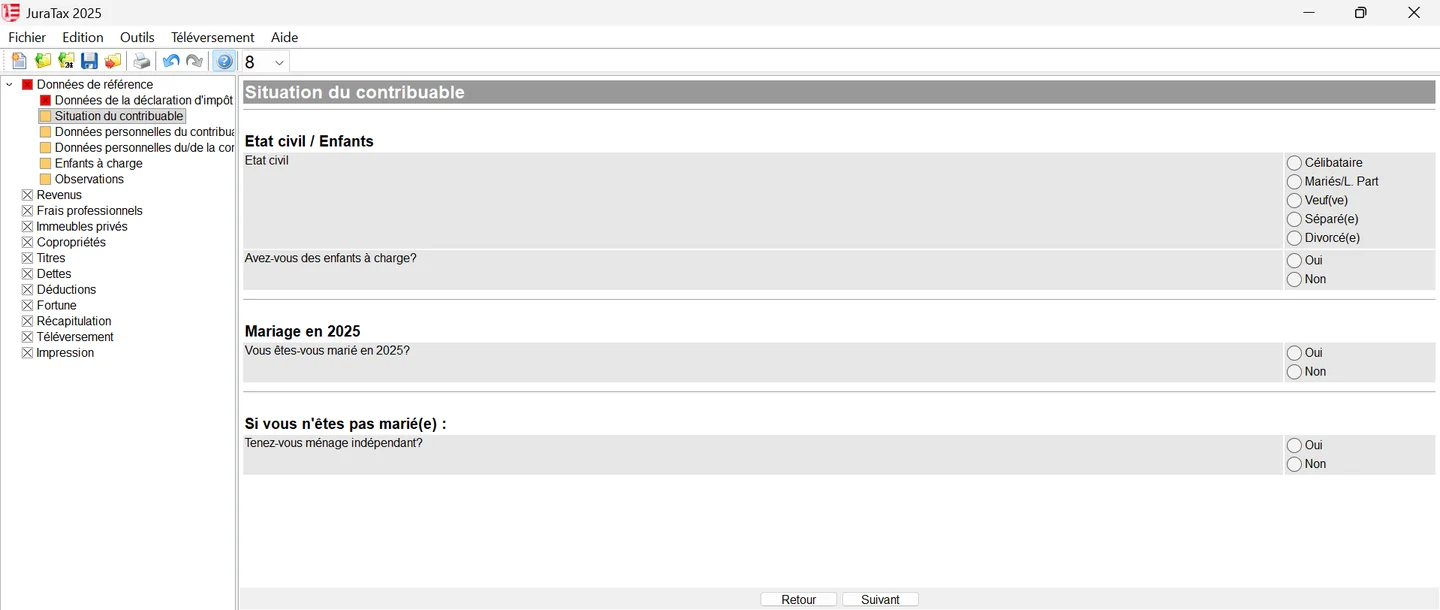
Under « Données de référence » (reference data), the « Situation du contribuable » (taxpayer's situation) screen asks for your marital status on 31 December 2026 (single « célibataire », married / registered partners « Mariés/L. Part », widowed « veuf », separated « séparé » or divorced « divorcé »), whether you have dependent children, whether you married during the year and, if not married, whether you run your own household. Your answers decide which screens follow.
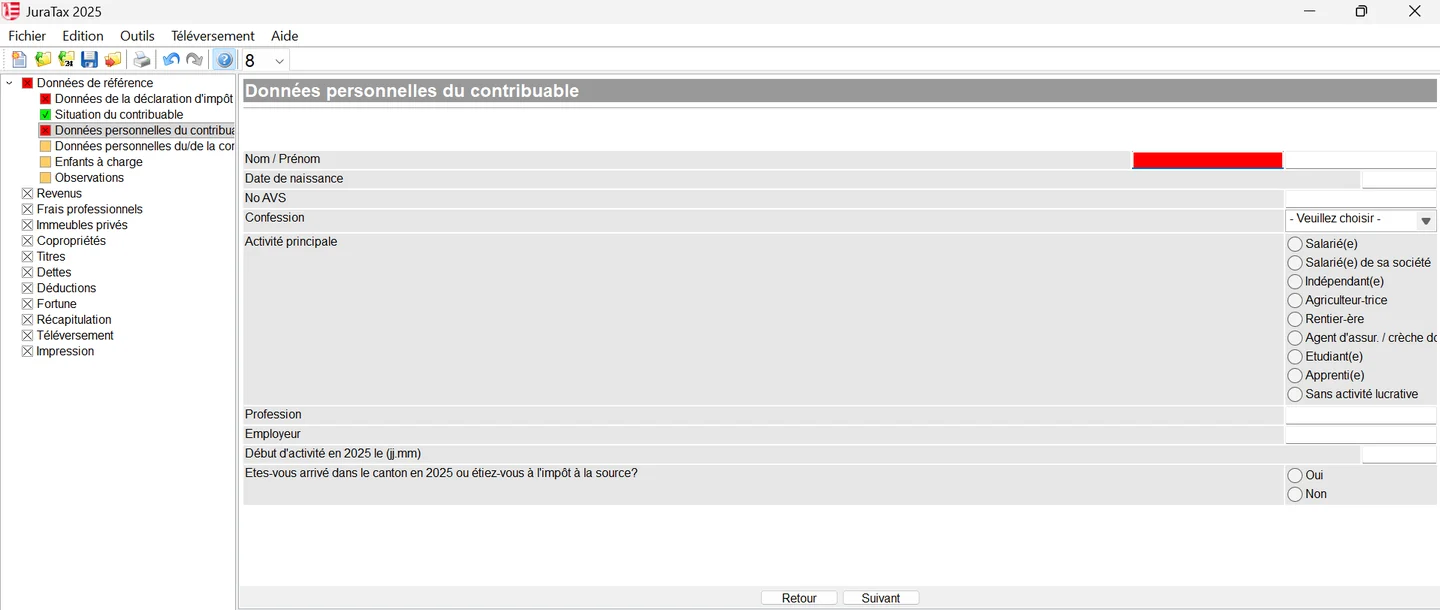
Next come « Données personnelles du contribuable » (taxpayer's personal data) and « du/de la conjoint(e) » (spouse's): surname and first name, date of birth, AHV number, religion, main activity, occupation, employer, start date of work in 2026 and an important question, « Êtes-vous arrivé dans le canton en 2026 ou étiez-vous à l'impôt à la source ? » (did you move to the canton in 2026 or were you taxed at source?). Answer yes if so: the tax service takes it into account in your assessment.
| Field | What to know |
|---|---|
| Religion (« Confession ») | Catholic, Reformed, other or none. Church tax is only due to parishes of recognised churches; the Christian Catholic church is not recognised in the canton of Jura |
| Main activity (« Activité principale ») | Employee, employee of your own company, self-employed, farmer, pensioner, insurance agent or home childcare, student, apprentice, not gainfully employed. This choice opens the matching income sections |
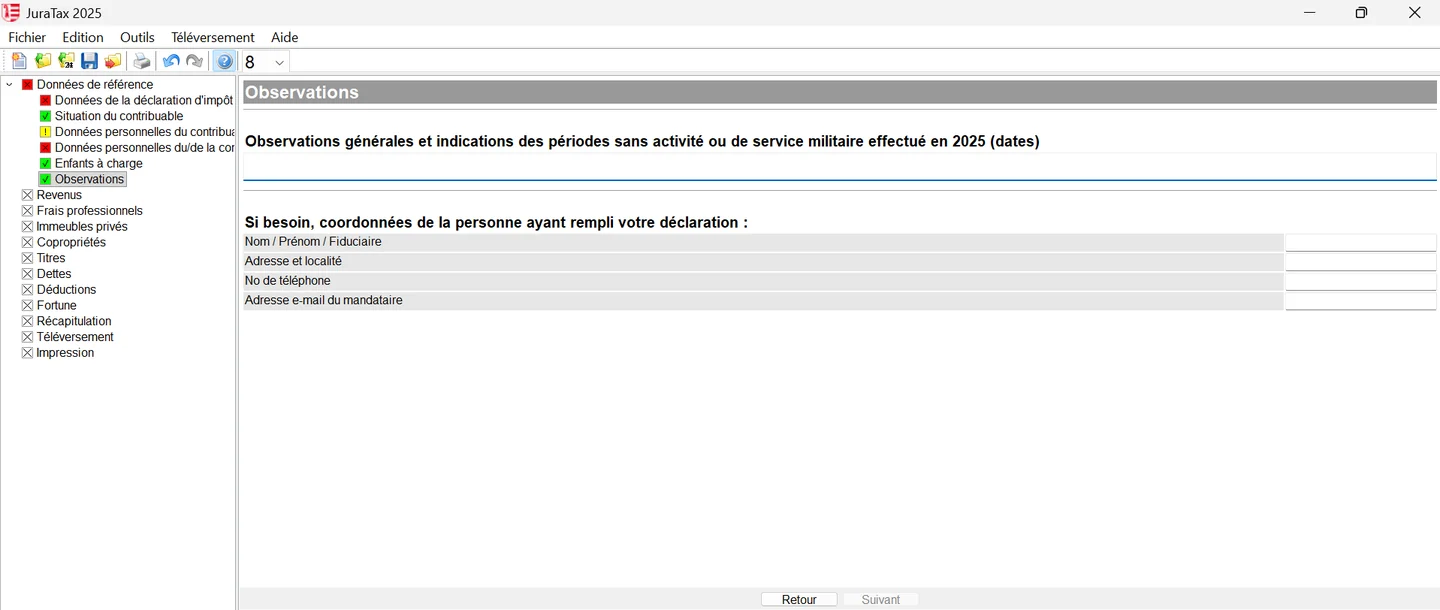
| Remarks (« Observations ») | « Observations » screen: periods without work and military service in 2026, with dates. They explain lower income or reduced work expenses |
| Representative | Same screen: the fiduciary's name, address, phone and email, if someone else completed your return |
Marriage, divorce, death in 2026
- Married in 2026: you are taxed jointly for the whole of 2026 and file a single return in the couple's name. Instalments billed separately are combined on the couple's account.
- Divorced or separated in 2026: each spouse is taxed separately for the whole year and files their own return. Half of the instalments paid on the couple's account goes to each former spouse, unless both ask jointly for another split.
- Death of a spouse: joint taxation ends on the day of death. The surviving spouse is then taxed alone; the return is sent to the estate's liquidator or the surviving spouse.
- Moving to another Jura municipality or another canton: the municipality or canton of residence on 31 December taxes the whole year.
Dependent children
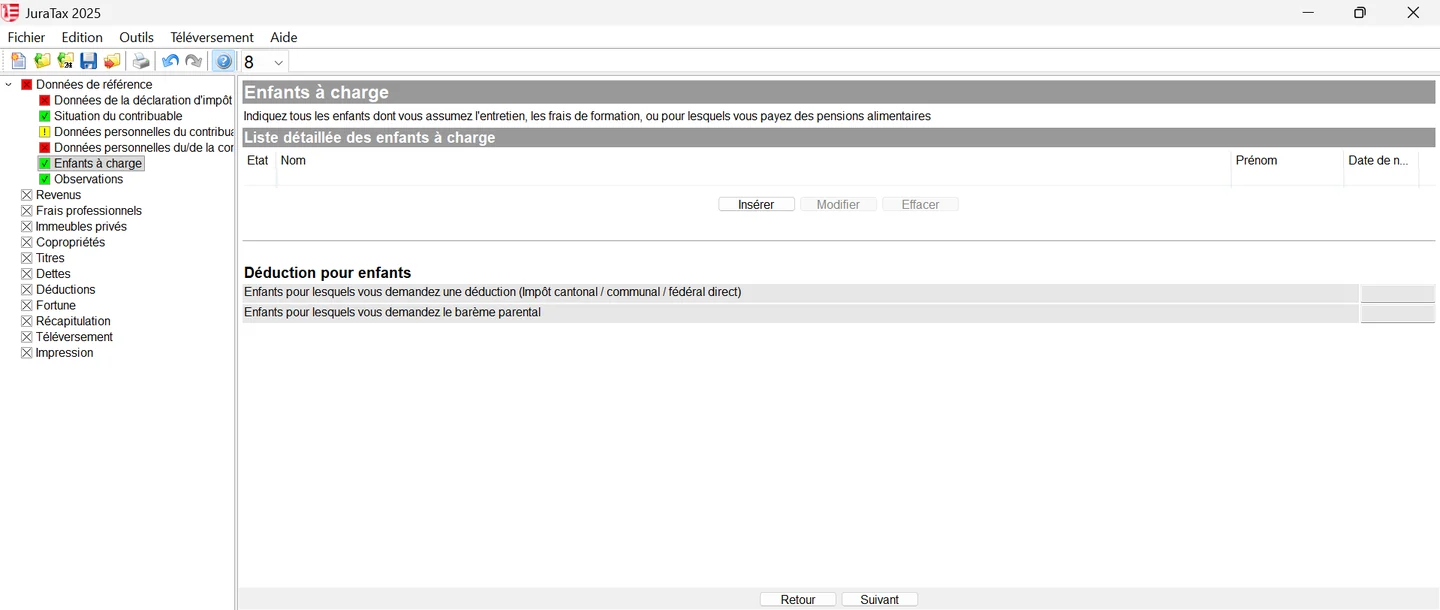
List children who are minors on 31 December 2026 under your parental authority and adult children in an apprenticeship or studying whom you mainly support. Under « Enfants à charge » (dependent children), click « Insérer » (insert) for each child (« Modifier » and « Effacer », edit and delete, correct the list). Below the list, JuraTax shows how many children you claim the child deduction and the parental scale for.
| Field on the « Données personnelles de l'enfant » form | What to enter |
|---|---|
| Surname, first name, sex, date of birth | As registered |
| « Vivez-vous avec cet enfant ? » (do you live with this child?) | Yes or no: decisive for the scale and the parental scale |
| « Situation des parents » (parents' situation) | Married, unmarried couple or other (separated or divorced parents) |
| « Autorité parentale officielle » (parental authority) | Yes, no or shared |
| « Garde alternée » (shared custody); lower income than the other parent | In shared custody, the parent with the lower income gets the married scale |
| Maintenance paid or received | Annual amount, with the other parent's name and address |
| « Frais de garde versés » (childcare costs paid) | Nursery, after-school care, childminder (code 555) |
| « Apprentissage ou études » (apprenticeship or studies) | Type of training, start, expected end, employer or school |
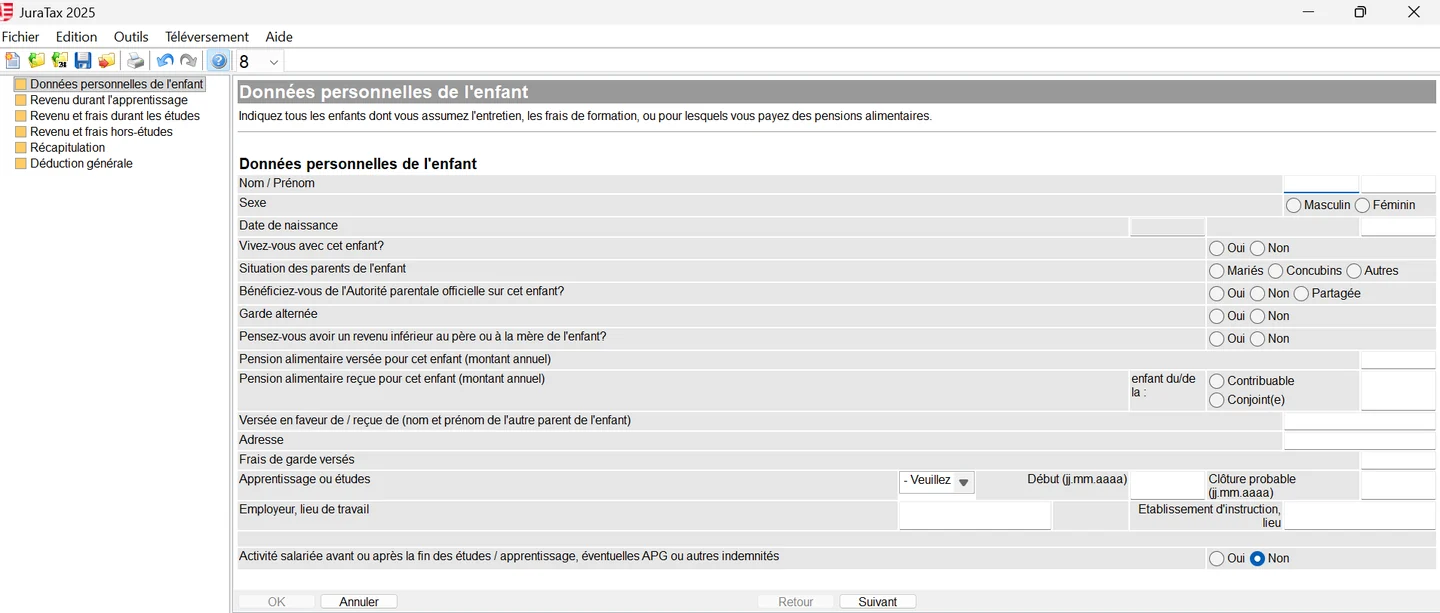
The income and wealth of minor children are added to those of the parent with parental authority: list their accounts in your securities list. Only the child's earned income (and property gains) is taxed separately. An adult child in training files their own return and can claim the apprentice or student deduction there (code 660).
Unmarried couples, separated parents, shared custody: who deducts what?
| Situation | Child deduction (620) and premiums (525) | Cantonal scale |
|---|---|---|
| Married couple | To the couple | Married scale |
| Unmarried couple, child born before 2014, no joint parental authority | To the parent with parental authority | Single scale for both parents |
| Unmarried couple with joint parental authority (always the case for a child born from 2014), no maintenance payments | Half to each parent | Single scale for both parents |
| Separated or divorced parents (2 households), joint authority, no maintenance payments | Half to each parent | Married scale for the parent living with the child; in shared custody, for the one with the lower net income (code 590) |
| Separated parents, adult child in training, with maintenance payments | To the parent paying maintenance, if the child is still dependent | Married scale for the parent living with the child |
IBAN and going paperless next year
Enter the account holder and IBAN (CH followed by 19 characters). The tax service only refunds an overpayment to an IBAN; otherwise the amount is credited to the current year. At the bottom of page 1, a box also lets you give up paper documents: tick it if you will complete next year's return with JuraTax. You will then no longer receive anything on paper.
Frequently asked questions
Is an adult child at university still a dependant in Jura?
Yes, if they are in an apprenticeship or studying and you mainly support them. List them with the letter A (apprentice) or E (student) and the end date of training. The deduction is not granted if their annual income, grants included, exceeds CHF 19,800.
Do unmarried couples with children get the married scale in Jura?
Normally not. The married scale is reserved for married couples living together and for people running a household alone with dependent children. Unmarried couples do not run a household alone and are each taxed on the single scale.
Who gets the married scale in shared custody?
For cantonal tax, the parent with the lower net income (code 590). The other parent is taxed on the single scale. Each receives half of the child deduction.
I got married in 2026: one return or two?
One. Spouses are taxed jointly for the whole year of marriage and file a joint 2026 return in February 2027.
Rather hand it over?
NeoFidu prepares and files your Jura tax return for you, including property, undivided estates and subsequent ordinary assessment (TOU) cases, with a check for missed deductions. Service in English available.
This guide is for information only and is not personalised advice. Amounts come from the 2025 general guide (« Guide général ») of the Jura cantonal tax service (Service des contributions), its official forms and the Swiss Federal Tax Administration's Jura cantonal sheet (February 2026), which states that indexed amounts remain unchanged for the 2026 tax period. JuraTax is not available in English: we quote the French labels, followed by a translation, so you can find them on screen. Screenshots show JuraTax 2025 with fictitious data. If in doubt, the tax service's general guide prevails.