Clic&Tax · Chapter 2/11
Personal situation in Clic&Tax: columns A and B, marital status, religion, children and additional information
Key points
- What counts is your situation on 31 December 2026 (or at the end of your tax liability). It determines social deductions, splitting and the church contribution.
- Single person: column A. Married couple or registered partners: the person named first in the address in column A, the spouse in column B, in a single return.
- The Neuchâtel church contribution is voluntary: it is invoiced according to the religion you state, but no debt collection is started if it is not paid.
- Each dependent child gives a deduction of CHF 6,200 to 8,200 depending on age and a CHF 200 rebate on cantonal tax. Unmarried couples share it equally.
Column A, column B
The Neuchâtel return has two columns. A single person (unmarried, widowed, separated or divorced) only fills in column A (« Contribuable colonne A »). Married people and registered partners file a joint return for the whole year, even if they married during the year: the person listed first in the address uses column A, the spouse column B. If you separated or divorced in 2026, each of you files your own return for the whole year. A working minor files their own return once their net income exceeds CHF 18,000; their other income and wealth go in the return of the parent with parental authority.
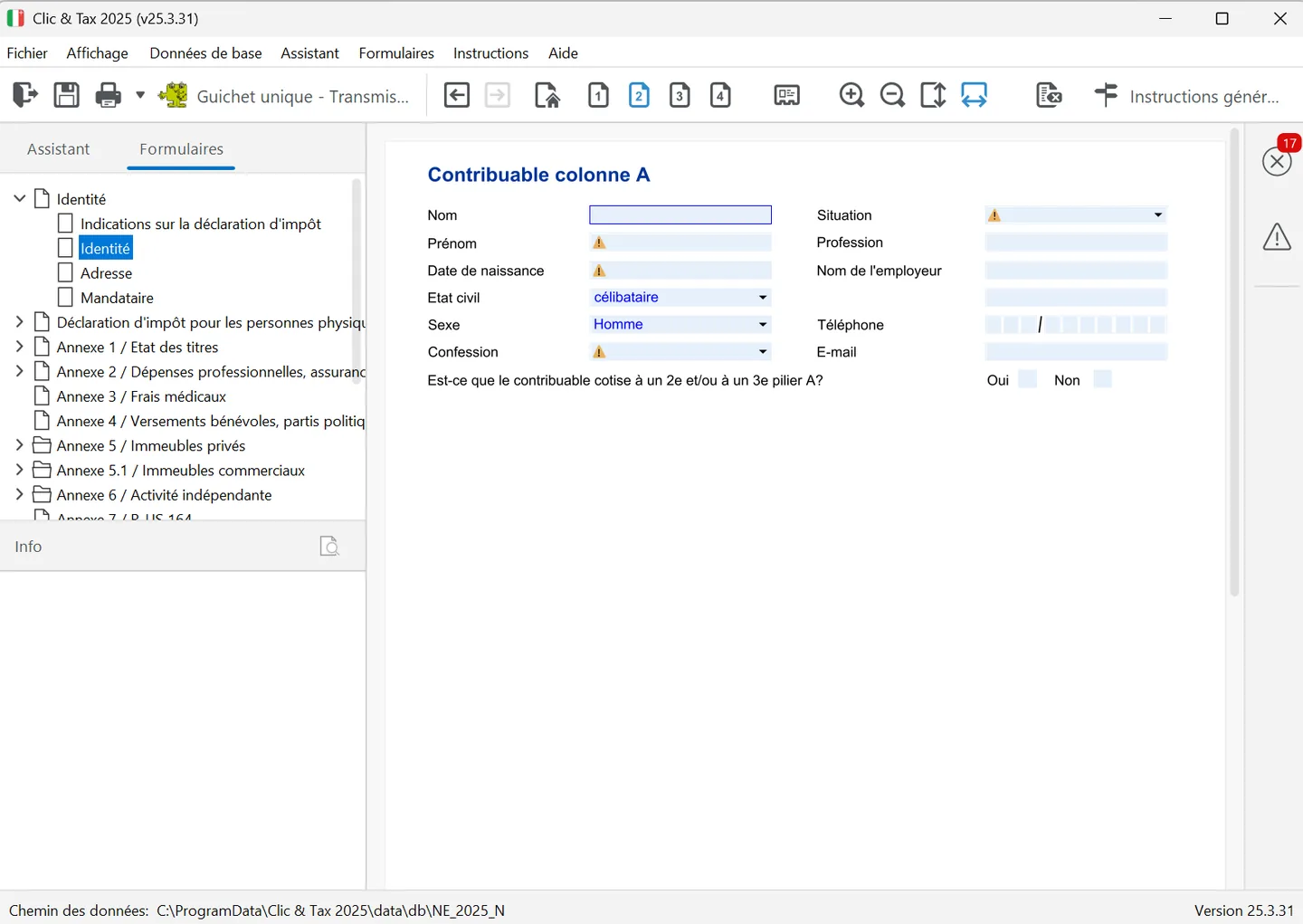
In Clic&Tax, these details go in the « Identité » branch of the « Formulaires » tab: the « Identité » page holds a « Contribuable colonne A » (taxpayer column A) sheet (and a column B sheet for the spouse), the « Adresse » page the mailing address (title, name, care of, PO box, street, postcode and town, country).
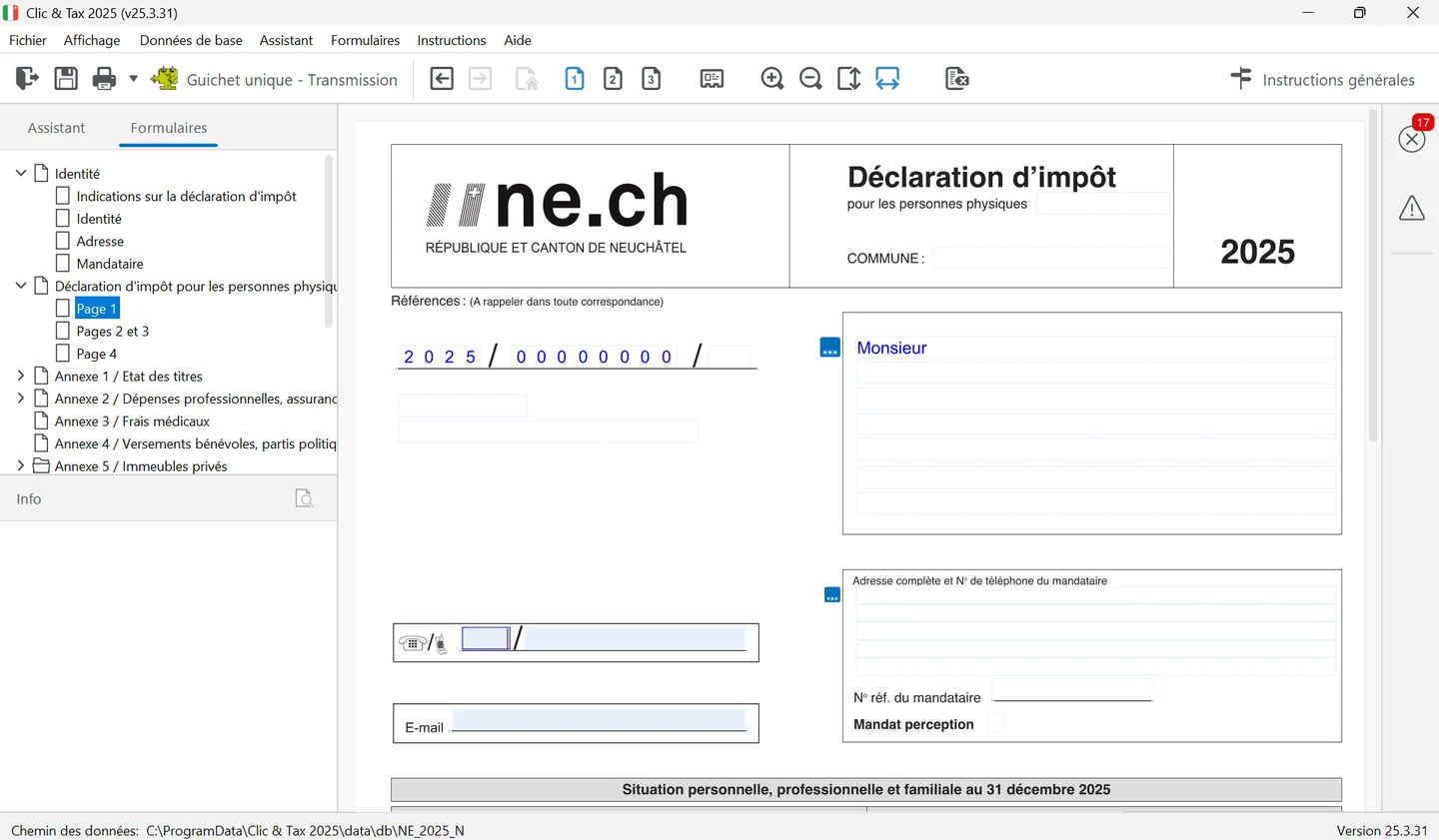
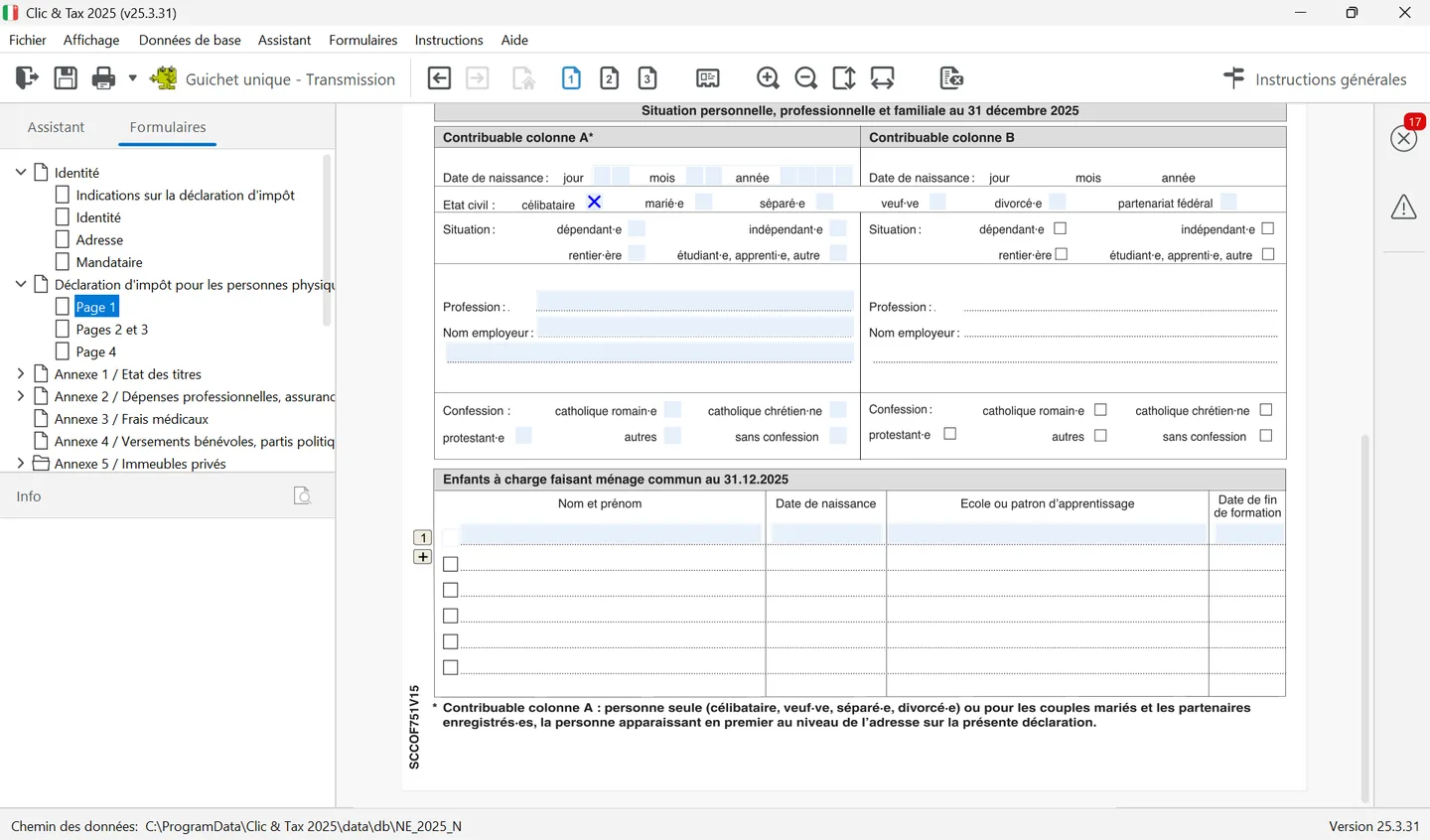
The « Déclaration d'impôt pour les personnes physiques » branch then reproduces the official form on three screens: « Page 1 » (reference, address, representative, personal situation and children), « Pages 2 et 3 » (income, wealth and deductions, items 1.11 to 11) and « Page 4 » (additional information). You can fill in these pages directly, as on paper.
Marital status, situation and religion
- Nom (surname), prénom (first name), date de naissance (date of birth) and sexe (sex), then téléphone and e-mail (optional).
- Marital status (« Etat civil ») on 31 December: « célibataire » (single), « marié·e » (married), « séparé·e », « divorcé·e », « veuf·ve » (widowed) or « partenariat fédéral » (federal registered partnership).
- Federal registered partnership: tick « partenariat fédéral ». It has the same tax effects as marriage. The Neuchâtel cantonal partnership, however, is not treated as marriage: do not tick this box.
- Situation: « dépendant·e » (employee), « indépendant·e » (self-employed), « rentier·ère » (pensioner), or « étudiant·e, apprenti·e, autre » (student, apprentice, other).
- Profession and employer name (« Nom employeur »).
- Religion (« Confession »): Roman Catholic, Christian Catholic, Protestant, other (« autres ») or none (« sans confession »).
- « Est-ce que le contribuable cotise à un 2e et/ou à un 3e pilier A ? » (does the taxpayer contribute to pillar 2 and/or pillar 3a?): answer carefully. Without pillar 2 or 3a, the cap on the insurance premium deduction (item 6.8) rises by 25% (see Deductions).
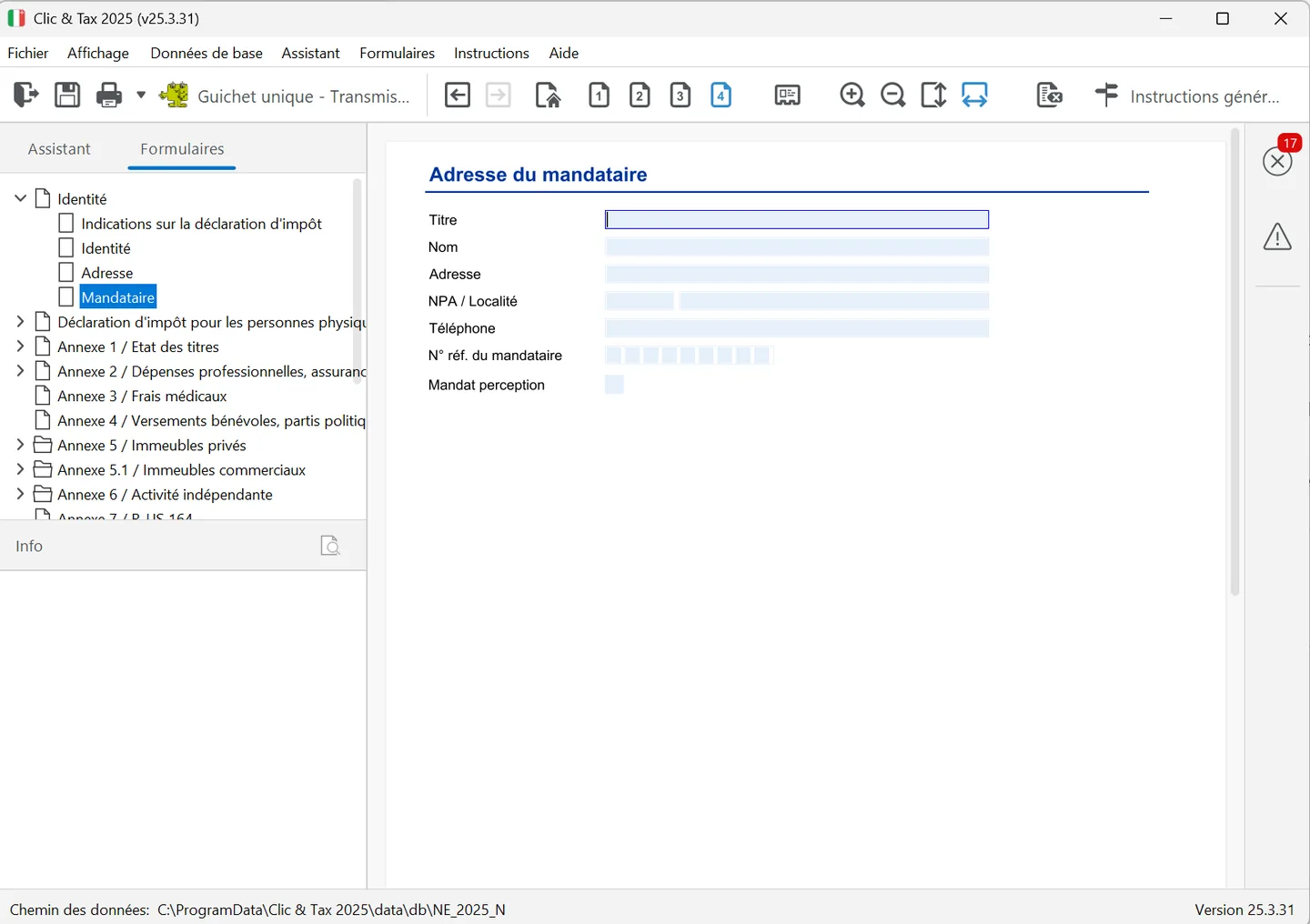
If a fiduciary prepares your return, its details go on the « Mandataire » (representative) page (« Adresse du mandataire »: title, name, address, postcode and town, phone, representative's reference number). The « Mandat perception » box also authorises it to view your tax current account and change your instalments. On paper, the return is signed by both spouses; with Clic&Tax only the receipt (« quittance ») is signed, and nothing at all if you file through the Guichet unique.
Dependent children
The « Enfants à charge faisant ménage commun au 31.12 » table (dependent children living with you on 31 December), at the bottom of Page 1, lists minor children and adult children in apprenticeship or studies who live with you: name and first name, date of birth, school or apprenticeship employer and end date of training. The « + » button adds rows. An adult child in training to whom you pay maintenance is declared in question 9 of the additional information (see below). The deduction depends on the child's age at the end of the year and increases as soon as the child reaches, during the year, the first year of the next age band.
| Child's age | Cantonal deduction (item 7.2) | Direct federal tax |
|---|---|---|
| 0 to 4 | CHF 6,200 | CHF 6,800 |
| 4 to 14 | CHF 6,700 | CHF 6,800 |
| 14 and over (in training) | CHF 8,200 | CHF 6,800 |
On top of the deduction, each child gives a CHF 200 rebate on cantonal income tax, calculated automatically. Single parents living with their children benefit from splitting (rate calculated on 52% of income) and the modest-income family deduction. The amounts of these deductions are set out in the Deductions chapter.
| Situation | Neuchâtel rule |
|---|---|
| Unmarried couple with a shared child | Each partner can claim half of the child deduction; otherwise it goes to whoever claims it or to the higher taxable income. Splitting does not apply to both. |
| Recognised alternating custody | Parents taxed separately, joint parental authority, equivalent stays and no maintenance paid: deduction split in half, splitting for the parent who bears most of the support |
| Alternating custody not recognised | Deduction and splitting go to the parent with parental authority, the larger share of custody or who receives maintenance |
| Adult child in training receiving maintenance | No child deduction for the paying parent, but a deduction for a dependent person in need (item 7.3) |
Additional information
On the back of the return, the additional information page (« Informations complémentaires ») asks nine questions. In Clic&Tax it is « Page 4 » of the return: tick the box of each question that applies to you and complete the fields. Maintenance entered in question 2 is carried automatically to item 2.5 (received) and item 6.10 (paid). Your IBAN for refunds (format CH followed by 19 characters) is entered in the program's « Questions complémentaires » section, whose answers are contained in the barcodes of the receipt.
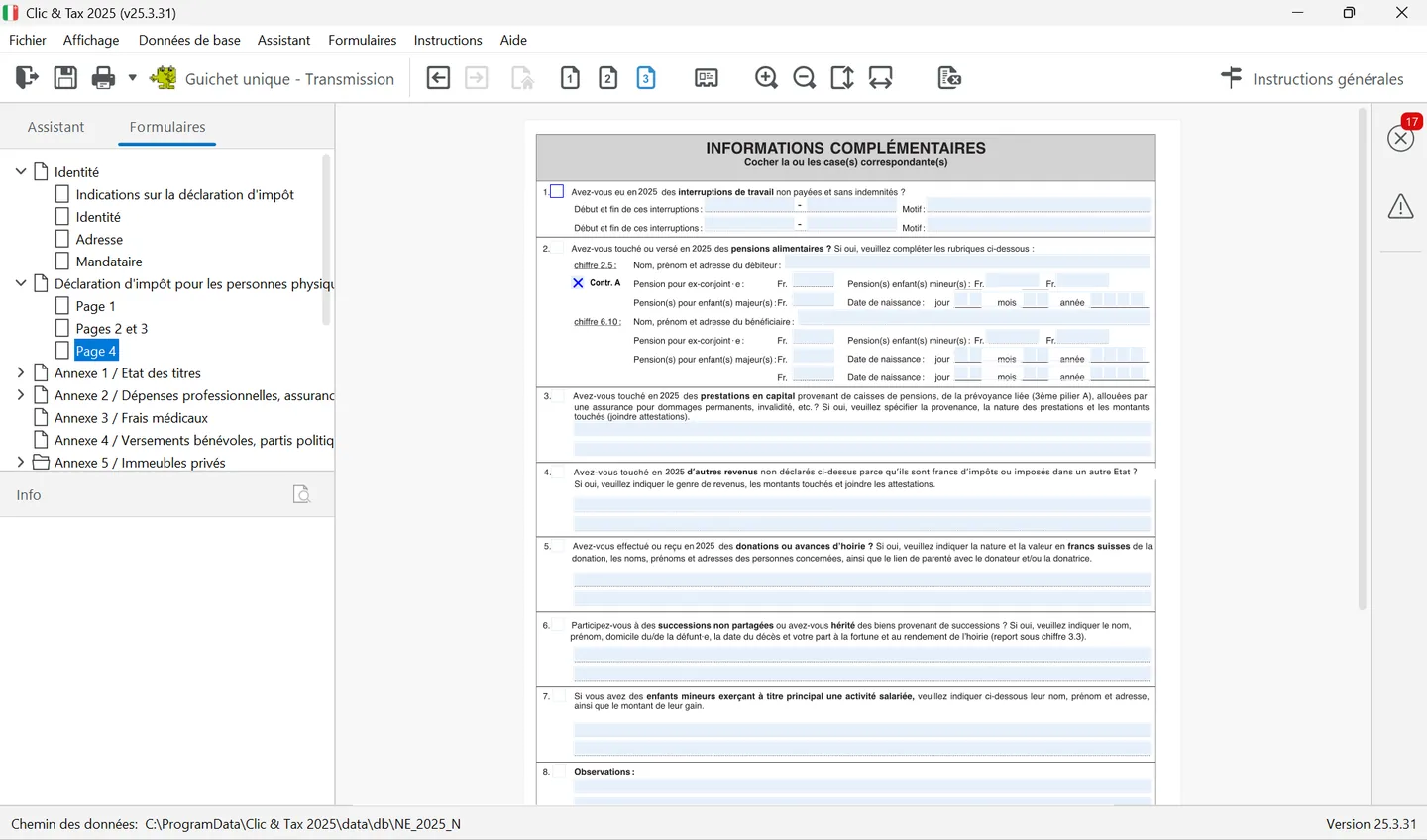
| Question | What to enter |
|---|---|
| 1. Work interruptions | Unpaid periods without allowances (illness, unemployment, unpaid leave) and the reason |
| 2. Maintenance payments | Amounts received or paid for an ex-spouse, minor and adult children, with the payer's or recipient's name and address |
| 3. Lump-sum benefits | Pension fund, pillar 3a or insurance capital received in 2026, with the certificates |
| 4. Income not declared | Exempt income or income taxed in another country, and wages under the simplified settlement procedure |
| 5. Gifts and advances on inheritance | Nature, value, people involved and family relationship |
| 6. Estates | Deceased person, date of death and your share of the wealth and income of an undivided estate (carried to item 3.3) |
| 7. Minor children in employment | Name, address and amount earned |
| 8. Remarks | Any information useful for your assessment |
| 9. Persons in need | People you support who cannot work, and adult children in training to whom you pay maintenance |
Moved to Neuchâtel from another canton during the year? Your domicile on 31 December applies to the whole year. If you arrived from abroad or moved abroad, only the time spent in the canton is taxed (see « NOTICE 1 »). Once your situation is complete, move on to salary and income.
Frequently asked questions
Who fills in column A and who column B on the Neuchâtel return?
A single person only fills in column A. For a married couple or registered partners, the person listed first in the address on the return uses column A, the spouse column B.
Is the church contribution compulsory in the canton of Neuchâtel?
No. It is invoiced according to the religion stated on the return, but paying it is voluntary: no debt collection is started if it is not paid.
How much is the child deduction in Neuchâtel in 2026?
CHF 6,200 for a child aged 0 to 4, CHF 6,700 from 4 to 14 and CHF 8,200 from 14 if in training, plus a CHF 200 rebate per child on cantonal tax. For federal tax, the deduction is CHF 6,800 per child.
How do unmarried couples share the child deduction?
Each partner can claim half of the dependent child deduction. Without a request, it goes to whoever claims it or to the partner with the higher taxable income.
Rather hand it over?
NeoFidu prepares and files your Neuchâtel tax return for you, including property, securities and subsequent ordinary assessment (TOU) cases, with a check for missed deductions. Service in English available.
This guide is for information only and is not personalised advice. Amounts come from the 2025 general instructions (« Instructions générales ») of the Neuchâtel cantonal tax service (Service des contributions), the overview of deductions for 2026 published in its 2026 interim instructions, its leaflets (« notices ») and the Swiss Federal Tax Administration's Neuchâtel cantonal sheet (February 2026). Clic&Tax is not available in English: we quote the French labels, followed by a translation, so you can find them on screen. If in doubt, the tax service's general instructions prevail.